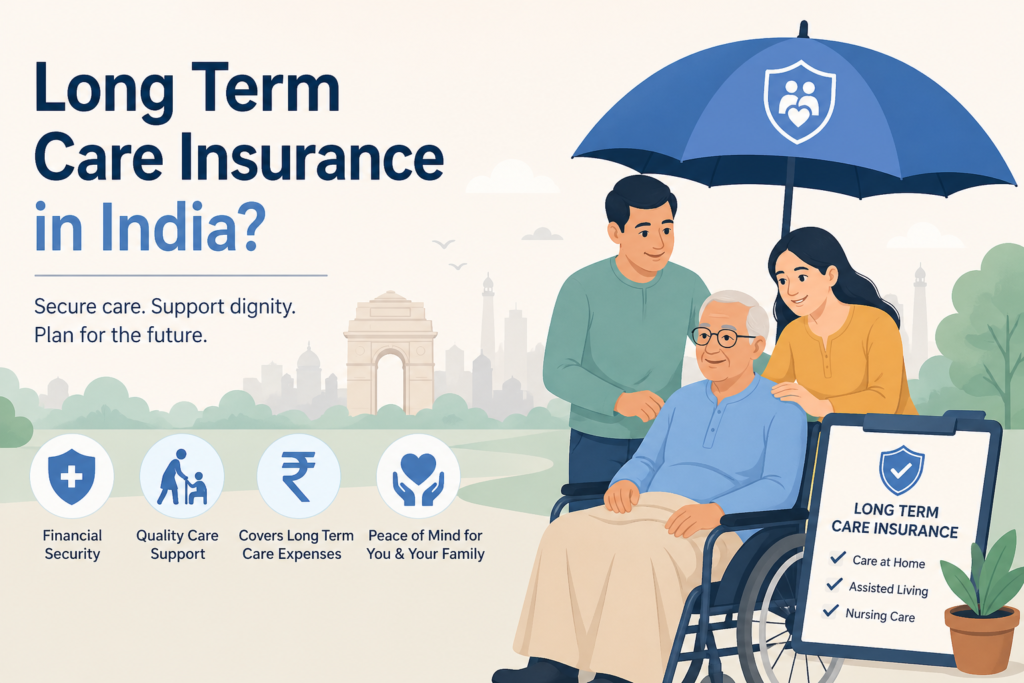
As India’s population ages, a critical financial question is gaining momentum: Is Long Term Care Insurance available in India? For most Indian families, caregiving has traditionally been a domestic responsibility. However, with shifting demographics and rising medical costs in 2026, the need for professional, long-term assistance—often called “custodial care”—is becoming a stark reality.
In this comprehensive guide, we will explore the current state of Is Long Term Care Insurance available in India?, the realistic alternatives, and how you can prepare for a future where you might need help with daily activities.

1. Defining Long-Term Care (LTC)
Before diving into the availability, it is essential to understand what Long-Term Care actually is. Unlike standard health insurance that covers hospital stays for acute illnesses (like a heart attack or an appendectomy), Long-Term Care focuses on Activities of Daily Living (ADLs). These include:
- Bathing and dressing
- Eating and mobility
- Managing chronic conditions like Alzheimer’s or Parkinson’s
Standard medical insurance is designed to get you “back on your feet,” while Long-Term Care is designed for when you cannot get back on your feet and need ongoing support at home or in an assisted living facility.
2. Is Long Term Care Insurance Available in India? (The Current Status)
To answer the core question: As of 2026, standalone Long Term Care Insurance policies are still uncommon in the Indian market.
Unlike in countries like the USA or Japan, you cannot easily walk into an insurance office and buy a policy dedicated solely to nursing home costs. However, the Indian insurance landscape—under the guidance of the IRDAI (Insurance Regulatory and Development Authority of India)—is rapidly evolving.
Where to Find LTC-Like Benefits Today:
Instead of a single “LTC Policy,” Indian consumers must look for specific riders and features within other plans:
- Critical Illness Insurance: These policies provide a lump sum payout upon the diagnosis of severe conditions (like a stroke or organ failure). This money can then be used to pay for long-term care services.
- Senior Citizen Health Plans: Many new-age senior plans now include “Home Care” or “Domiciliary Hospitalization” covers.
- Terminal Illness Riders in Term Plans: Some term insurance plans allow for an “accelerated payout” if the policyholder is diagnosed with a terminal condition, providing immediate funds for care.
3. Comparison: Standard Health Insurance vs. Long-Term Care Features
To help you visualize why a standard policy might not be enough, here is a breakdown of how different plans handle long-term needs in India.
| Feature | Standard Health Insurance | Senior Citizen Health Plans | Long-Term Care Riders (Current State) |
| Hospitalization Cover | Yes (Primary focus) | Yes (Includes sub-limits) | Not applicable |
| Home Nursing Care | Usually 60–180 days | Limited coverage | Payout based on diagnosis |
| Daily Activity Support | No | No | Indirectly via lump sum |
| Entry Age | No limit (Post-2025) | 60 to 75+ | Varies by base policy |
| Physiotherapy at Home | Rare/Limited | Often included | Covered via claim funds |

4. The Rising Cost of Care in 2026
Understanding Is Long Term Care Insurance available in India? also requires looking at the costs you are trying to cover. The “old age home” industry in India has split into various tiers, making financial planning essential.
Realistic Monthly Costs for Assisted Living (2026 Estimates):
- Basic Residential Homes: ₹25,000 – ₹60,000 per month (Shared rooms, basic meals, no medical care).
- Assisted Living Communities: ₹60,000 – ₹1,50,000 per month (Help with bathing, medicine, and mobility).
- Premium Medical Care/Luxury Homes: ₹1,50,000+ per month (24/7 nursing, private suites, and specialized diets).
Without a dedicated Long-Term Care policy, these costs must be met through personal savings or the “lump sum” payout from a Critical Illness plan.
5. New IRDAI Guidelines (2025–2026 Reforms)
The reason for optimism regarding Is Long Term Care Insurance available in India? lies in the recent regulatory shifts. The IRDAI has made several changes that pave the way for more inclusive long-term products:
- Removal of Age Barriers: Insurers can no longer deny a new health insurance policy solely because the applicant is over 65.
- Reduced Moratorium Period: After 5 years of continuous coverage, an insurer cannot reject a claim for non-disclosure (except for proven fraud), providing long-term security.
- Inclusion of Severe Conditions: Insurers must now offer products even for high-risk individuals suffering from severe pre-existing diseases.
6. How to Build Your Own “Long Term Care” Strategy
Since a standalone policy is rare, how can an Indian family prepare?
- Start Early with Health Insurance: Buy a comprehensive health plan in your 30s. The reduced waiting periods for pre-existing diseases (now capped at 3 years by IRDAI) mean you are fully protected by your senior years.
- Add a Critical Illness Cover: Ensure you have a cover of at least ₹15–25 Lakhs specifically for critical illnesses. If a stroke or paralysis occurs, this lump sum acts as your de-facto “Long Term Care” fund.
- Invest in Senior-Specific Savings: Use instruments like the Senior Citizens Savings Scheme (SCSS) to create a dedicated “Care Fund” that is separate from your general retirement corpus.
- Look for “OPD” and “Domiciliary” Features: When renewing your health insurance, prioritize plans that cover home-care expenses and physiotherapy, as these are the most common long-term care needs.
7. The Future of LTC in India
The NCAER and other economic bodies have noted that India is facing a “silent elderly care crisis.” As the population over 60 is expected to reach 230 million by 2036, it is highly likely that more insurers will introduce standalone Long Term Care Insurance products in the near future.
For now, the answer to Is Long Term Care Insurance available in India? is a “No” for standalone plans, but a “Yes” if you know how to assemble the right riders and health insurance features.
8. Checklist for Beginners
- Do you have a basic health insurance policy?
- Does your current policy have a “Critical Illness” rider?
- Have you checked if your policy covers “Domiciliary Hospitalization” (care at home)?
- Are you aware of the 15% discount for women and other benefits in modern term plans?
9. Conclusion
While the market is still maturing, the tools to protect yourself are already here. By combining a robust health insurance plan with critical illness riders and proactive savings, you can ensure that you or your loved ones receive the dignity and care they deserve in their later years.
Do read: What Is Long Term Care Insurance in India?
References for Further Reading:
- IRDAI Official Consumer Education Website
- Latest IRDAI Health Insurance Guidelines (2025-26)
- NCAER Report on Elderly Care in India
Disclaimer: This article is for educational purposes only and does not constitute financial or legal advice. Insurance products are complex; please consult with a certified advisor before making a final decision.